🧠
Persistent memory
An mmap-backed embedding store (.psmem) with semantic search. Pin facts, preferences and decisions once — every agent recalls them in a 15 ms local lookup, not a token-burning re-derivation.
 PriorStates
Download
PriorStates
Download
Coding agents start every session cold. Install PriorStates once and every AI tool on your machine — Claude Code, Codex, Gemini, Copilot, and Cursor (and other MCP clients) — shares one local memory and research journal, automatically. What one session learns, the next one remembers — instead of burning tokens re-exploring, re-explaining and re-running what you already paid for.
Memory and journal are the product — your agents use them on their own. Everything else is an optional window in.
An mmap-backed embedding store (.psmem) with semantic search. Pin facts, preferences and decisions once — every agent recalls them in a 15 ms local lookup, not a token-burning re-derivation.
Append-only entries with outcomes, topics and a generated index. Agents log what they tried and what won, so experiments aren't silently re-run — or paid for — twice.
A local web cockpit and a desktop app let you browse, search, edit or delete anything your agents store. You never have to open them — they're your window in, not a tool to learn.
mdlab: runnable Markdown — prose, code and results in one file. Remote projects: the engine runs on your server, the UI comes back over SSH.
Grab the installer for your OS — or one command / one sentence to your agent. No model download needed; a built-in hashing embedder works out of the box.
The installer registers the MCP server and a pinned context block into every detected agent — Claude Code, Codex, Gemini, Copilot, and Cursor (plus Windsurf, Antigravity and other MCP clients).
Use your agents exactly as before — each session starts with memory and journal already live. There's nothing to open, run or remember.
Under the hood — how "automatically" works
Wiring an agent does exactly two things: it registers a local MCP server (the tools — search, store, journal) and injects a short protocol block into the agent's own instructions (the habit — recall before answering, record durable findings as you go). The agent decides when to call the tools, the same way it decides when to read a file. No background process — the agent spawns the tools on demand over stdio and they exit with it; an idle machine runs nothing. Nothing is captured silently. Every memory is a plain Markdown file on your disk that you can read, edit or delete — and you can always just tell your agent "remember this."
One local store, surfaced where you work.
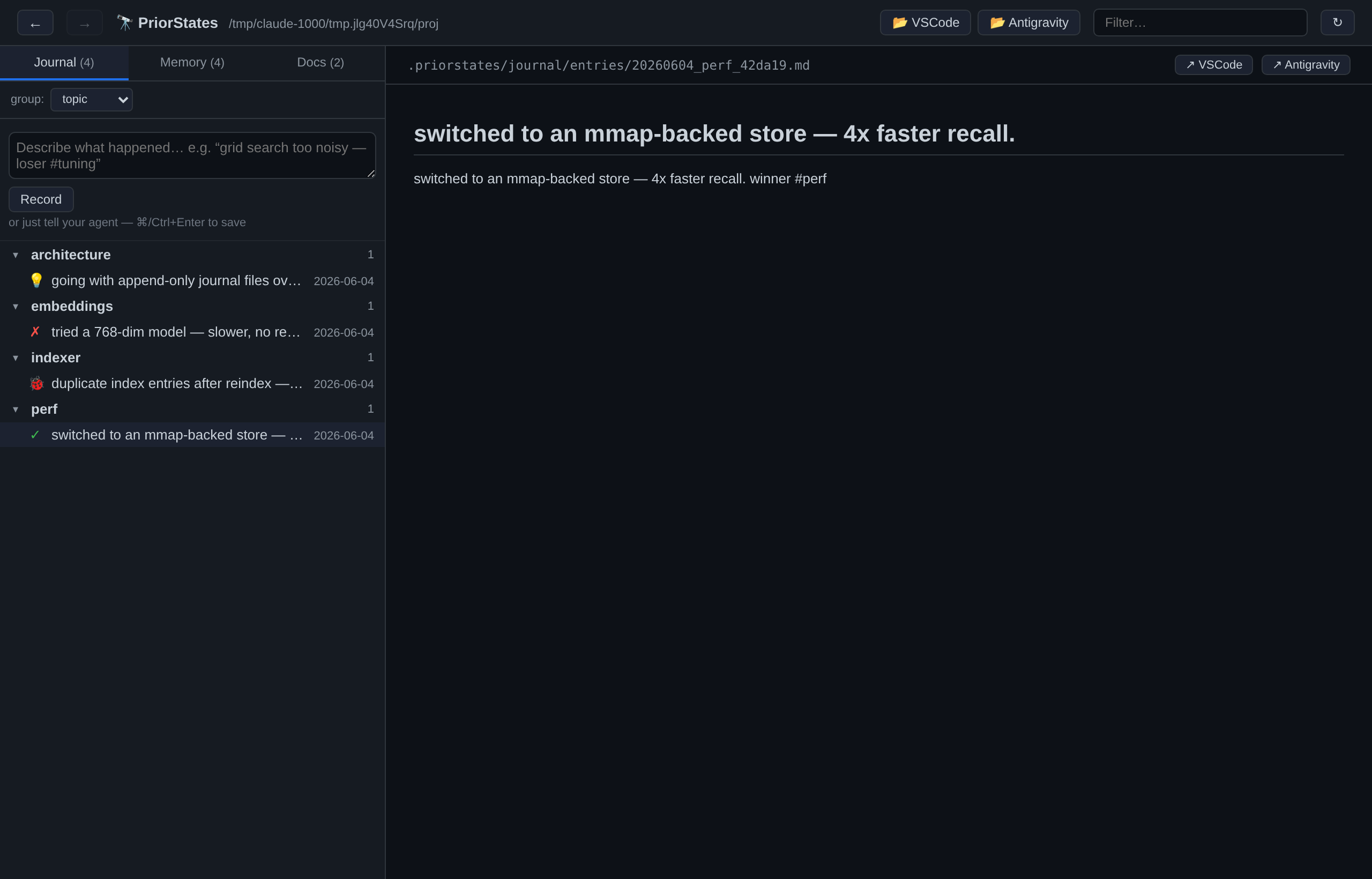
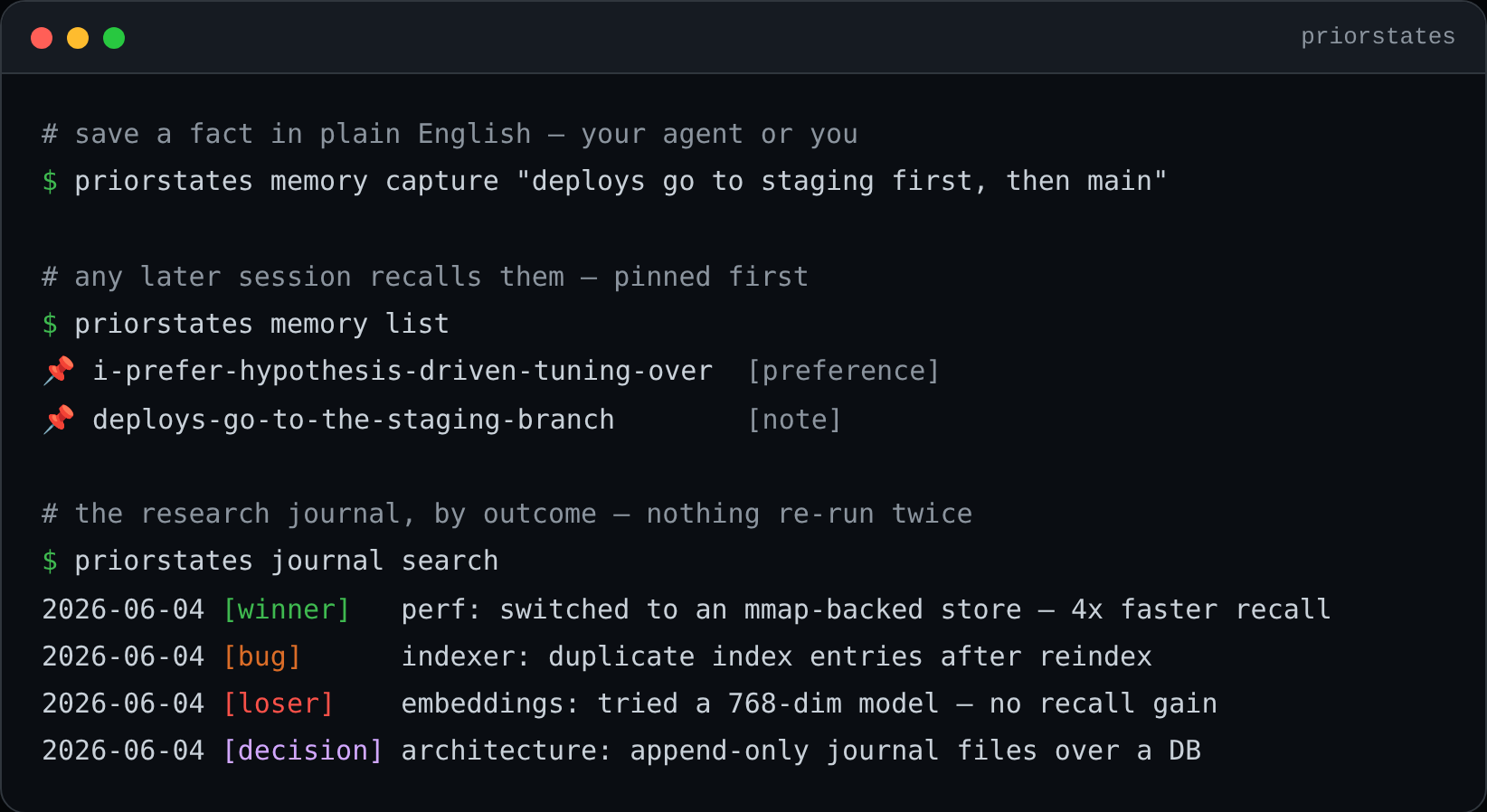
PriorStates wires its tools in via the Model Context Protocol (MCP) and a pinned context block — no lock-in, no rewrites.
Install once and they're all wired: priorstates agents install runs automatically — and unwires just as cleanly.
One installer sets up the package and wires every AI tool it finds — MCP server plus a recall-first protocol block — so your agents use memory automatically.
One installer per OS — Linux .deb / .rpm / .tar.gz, macOS .pkg, Windows Setup.exe. No pip, no terminal needed.
curl -fsSL https://priorstates.com/install.sh | shOr pip install priorstates — same result: every detected agent wired.
Already using Claude, Codex or Gemini? Just tell it:
Install PriorStates: fetch https://priorstates.com/install.md and follow it.It reads the install instructions, installs the package, wires itself over MCP, and verifies — then restart it to load the new memory + journal tools.
All options on one page — installers, one-liner, pip & source: Download & install →
Everything — memory, embeddings, journal, the cockpit — runs locally on your machine. CPU-only; no API keys, no telemetry, no cloud calls. Out of the box it uses a zero-download hashing embedder (Unicode-aware, so it works in any language) — nothing to fetch. Want stronger semantic recall? Opt in to a one-time ~127 MB model — or a ~130 MB multilingual one (50+ languages, cross-lingual recall) — that also runs entirely locally.
Free, open source, and yours to run.