
Build little apps with AI on your phone, and share them with people you know.
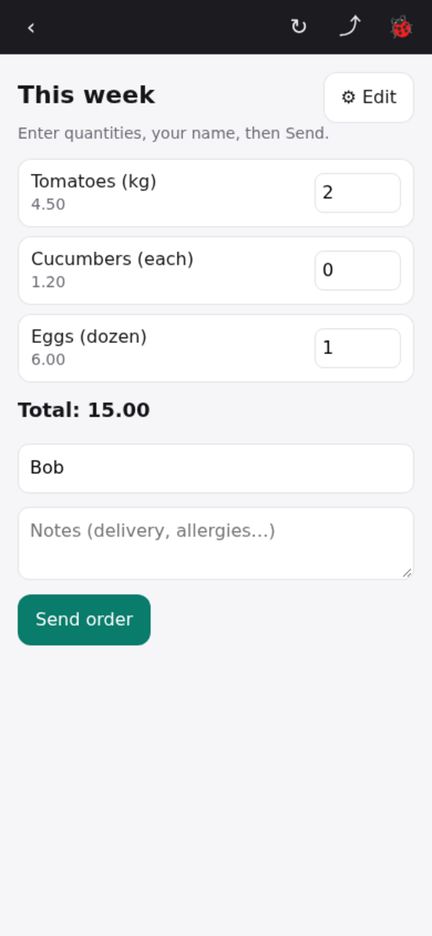
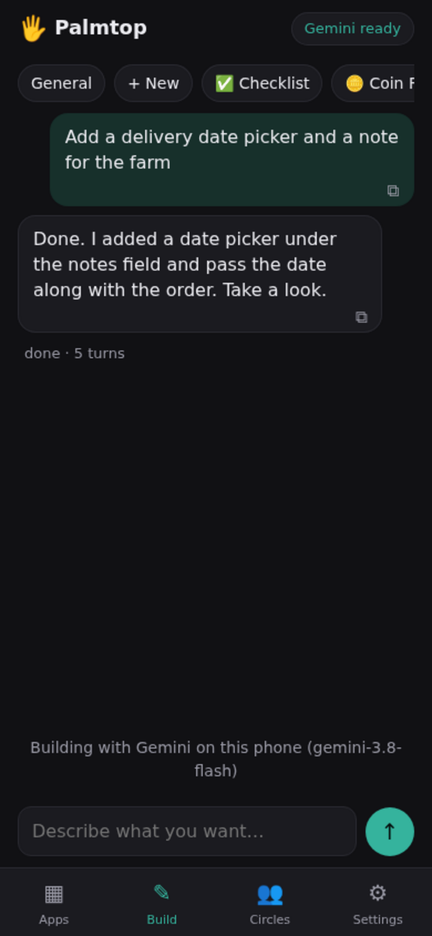
Describe what you want — “an order form for this week's vegetables”, “a packing checklist”, “the desk's morning numbers” — and the AI builds it, right there on the phone, in about a minute. Open it, change it by asking, keep it. The same apps use the whole window on your computer, with the same data, and go to anyone you send them to.
Say what you need. Then hand it to someone.
Palmtop is for the small things software should have made easy years ago: the order list for your farm, the chores rota, the group poll, the tracker that is exactly what you want.
Describe it
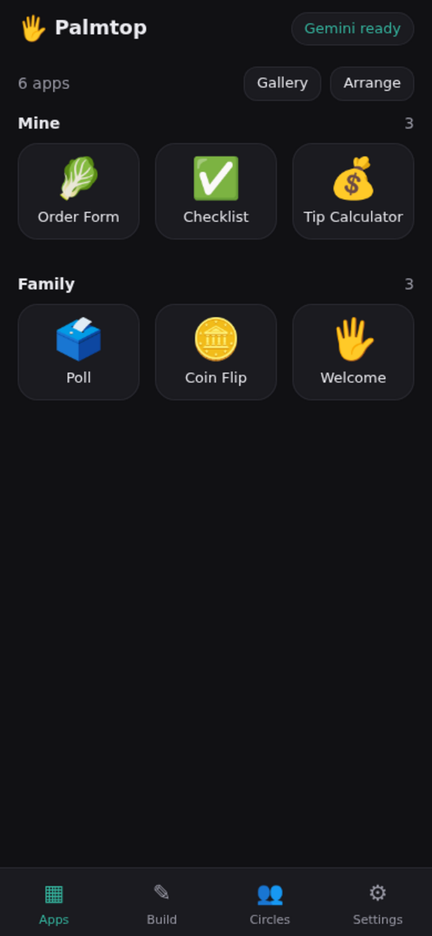
One sentence becomes an app on your grid. Open it, ask for a change, keep it. Nothing to install per app.
Share it
Send an app as a link or a file — through WeChat, WhatsApp, iMessage, email, anything. You choose whether your data goes along; a filled-in list can be the whole point.
Circles
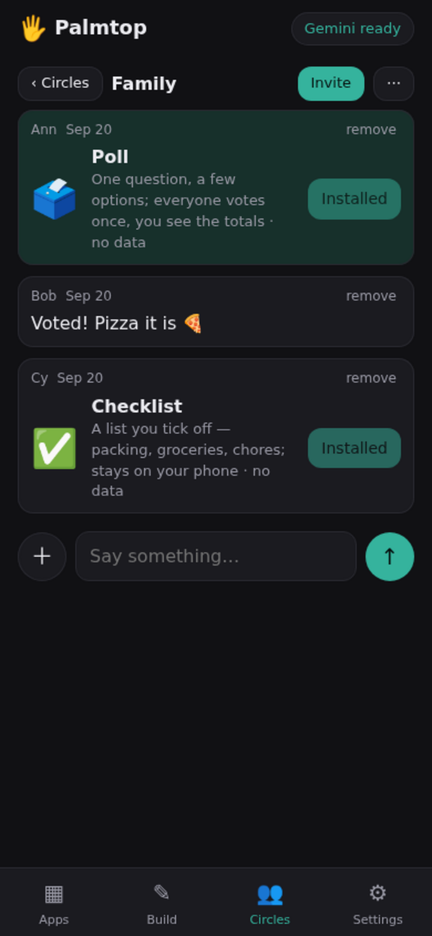
A family, a class or a team that share apps with one tap. Post an app, everyone gets Install; post an update, everyone gets Update.
Replies
A form you share sends its answers back to you. Orders, sign-ups, votes — collected in your Inbox, exported to a spreadsheet. How the round trip works.
Start from a template
The Gallery has more than you start with — an expense splitter, a trade blotter, and the rest — and every one of them is a working app you then change by asking.
It can reach your files
An app can ask your own computer for something — today's numbers, a file, a report — if you have set that up. It asks by name, for the things you allowed, and an app someone sent you can never do it at all. Palmtop Hub.
Tell me when it breaks
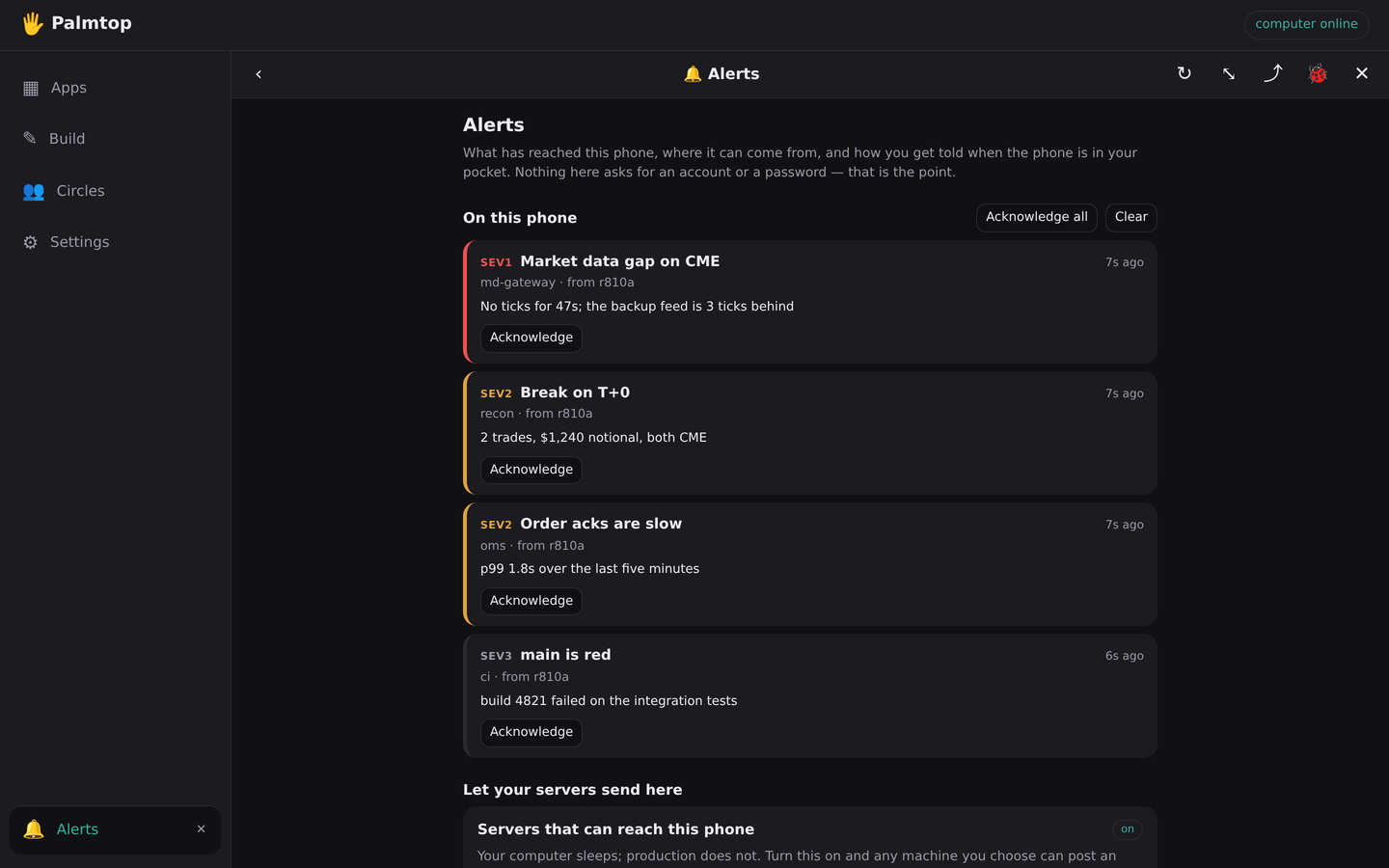
Your servers, your build, your monitoring — whatever already knows something is wrong — can put it on your phone, and ring it for the serious ones. Palmtop Link.
Ready to work
It arrives with an order form, a rota, a checklist, a poll, an alert board and an incident board, grouped by what they are for. Open one and change it into yours.
Bring your own AI
Paste a free Google AI Studio key and Palmtop builds by itself on your phone — or pair it with your computer and let the Claude Code there do the building and keep your apps in git.
How it works
The phone is the body; the AI is the brain. You pick which brain.
Holds the apps and their data. Describes what it wants; runs what comes back. Shares by link, file or circle.
Either Gemini with your own free key, straight from the phone — or the Claude Code on your computer, paired once by QR code, which builds and keeps your apps in git.
Your key and your apps stay on your device. Requests go from your phone straight to the AI provider, or to your own computer. Setting either up takes a minute — the quick start walks through both, and through the build → run → change loop; the computer side is Palmtop Hub, below, and your servers are Palmtop Link.
Palmtop Hub — your own AI, and your own files
One of the two optional parts that do what a phone cannot. It runs on your computer and builds your apps with the coding agent you already have there — Claude Code or Codex, on the subscription you already pay for. It keeps your apps in version control, and lets an app reach a file, a database or a printer that never leaves the machine. Install it, press Start, then Pair and scan the QR code with your phone. The phone then builds through that computer, and your apps are kept in git there. It keeps the computer awake while it runs. A phone with a Gemini key needs none of this.
⬇ Get Palmtop Hub — macOS, Windows, Linux
The hub needs a coding agent installed and signed in on that computer, and git. It uses your own login — no credential ever leaves the machine. The same hub also answers for PriorStates Resume Writer; its page has the downloads and how to connect each app, and the quick start walks through pairing.
Palmtop Link — alerts from your systems
The other optional part. The machines that know something is wrong are the ones that stay awake: a production server, a cron box, a CI runner. Palmtop Link is one static binary you put on them, and they put alerts on your phone — no pairing, no daemon, no inbound port, nothing running on the phone. Built for a trading desk at 3am, and just as good for “an order came in”.
Five minutes
Install the binary, tap Add a server on your phone for a code that works once, spend it. Then one line from anything that can start a process.
It can ring
A sev1 wakes the phone and stays on the screen until you deal with it; quieter things wait on the board. Best-effort, not a pager — so a real 3am page can place a call as well.
One-way by design
What a server holds can only add an alert to one phone's board. It cannot read that board, reach your computer, or see your other machines — and each is revoked on its own.
Every alert is sealed on the sending machine to a key only your phone holds, so the relay carries bytes it cannot read. Palmtop Link and the downloads · the integration guide.
Private by design
No accounts. No tracking. The one server we run is a blind relay: it moves encrypted bytes between phones and computers and cannot read them.
Try it on your phone.
The web app works today; the Android and iPhone apps follow.